
🎹 Best Online Piano Lessons for Beginners:
Why OnlinePianoLessons.com Is one of the Best
Jump to: What You Get • Who It’s For • Curriculum • Pros & Cons • Comparison • Pricing • 14-Day Practice Plan • FAQs
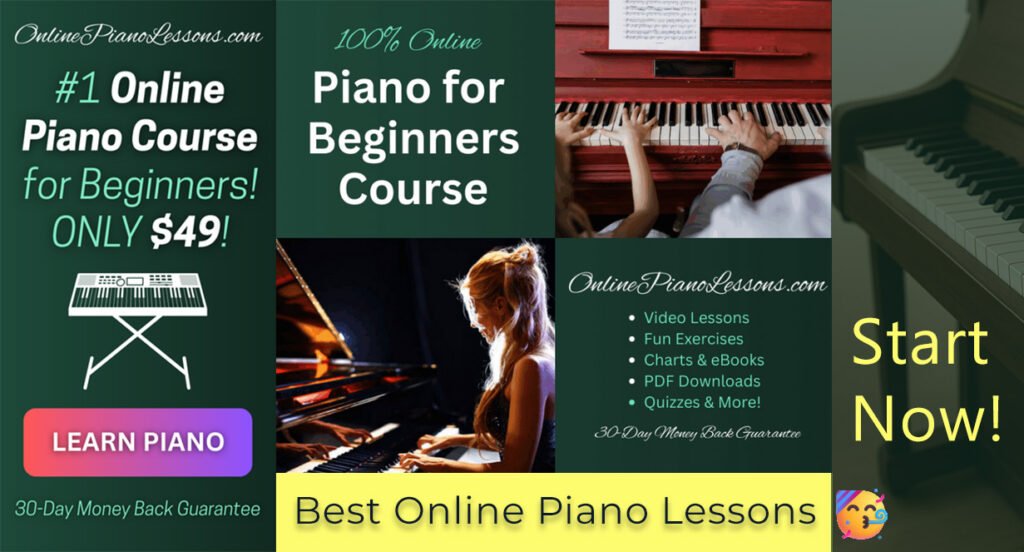
🎯 Start the Piano for Beginners Course Now
BEGINNER FRIENDLY + STEP-BY-STEP + VIDEO-BASED
If you’re starting from zero (or picking it back up), OnlinePianoLessons.com – Piano for Beginners is a concise, structured program designed to get you playing real music fast—without endless theory detours. Whether you are a beginning musician, or a musician or producer who always wanted to be able to play piano, In this review, I’ll break down the lesson flow, what you actually learn, who it’s ideal for, and how it compares to other popular platforms. You’ll also get a no-fluff practice plan to make real progress in the first two weeks. OnlinePianoLessons.com can work for kids and adults alike. ✨
✅ What You Get in the Course
- ✔️Short, progressive video lessons that stack skills in a clear order.
- ✔️Foundational technique: posture, hand position, finger numbers, timing.
- ✔️Play from day one: simple songs & patterns you can actually perform.
- ✔️Practice materials: downloadable charts/assignments to lock in each skill.
- ✔️Beginner-friendly pacing—no jargon, just what you need to play confidently.
🎯 Who It’s Perfect For
- Absolute beginners who want a clear start that doesn’t overwhelm.
- Returners who learned as kids and want a refresh with modern methods.
- Producers/composers who need keyboard fluency for songwriting and beat-making.
- Busy adults who prefer focused modules instead of open-ended “Netflix-style” lesson libraries.
📚 Inside the Curriculum (High Level)
- Setup & Fundamentals – posture, hand placement, finger numbers, basic rhythm.
- First Notes & Patterns – simple melodies, two-hand coordination with easy drills.
- Rhythm & Timing – counting, steady practice loops, playing with a click/backing.
- Chords & Progressions – practical triads to accompany melodies quickly.
- Reading Essentials – enough notation to follow the pieces you’ll play.
- Putting It Together – short songs you can perform and build on.
👍 Pros & 👀 Considerations
Pros
- Fast path to actually playing songs—not just theory.
- Clear structure without decision fatigue.
- Beginner pacing—bite-size wins each session.
- Downloadable materials make practice plug-and-play.
- Affordable entry vs. private lessons.
Considerations
- If you prefer a huge course library and “choose-your-own-adventure,” a big platform may suit you better.
- Advanced jazz/classical paths will require follow-up courses after you finish the beginner track.
🆚 How It Compares to Popular Alternatives
🎵 Enroll Today — Start Playing Your First Songs
| Platform | Best For | Learning Style | Beginner Friendliness |
|---|---|---|---|
| OnlinePianoLessons.com – Piano for Beginners | Absolute beginners; focused path to first songs | Structured, linear modules with downloads | ★★★★★ |
| Big Library Platforms (e.g., general lesson sites) | Explorers who want lots of styles/teachers | On-demand library; you choose the plan | ★★★☆☆ |
| Private Lessons | Personal feedback, performance coaching | 1:1 weekly sessions | ★★★★☆ (higher cost) |
💵 Pricing, Guarantee & Access
One-time beginner course purchase. Designed to be budget-friendly vs. monthly lesson platforms.
Vendor advertises a money-back guarantee (check the checkout page for current terms). ✅ Get Instant Access
Pricing and guarantee can change—always confirm on the official checkout page.
🗓️ 14-Day Beginner Practice Plan (Save This!)
Daily time: 20–25 minutes. Consistency beats marathon sessions.
- Days 1–2: Posture, hand shape, finger numbers. Count aloud with slow quarter-notes.
- Days 3–4: Right-hand five-finger patterns; simple two-bar melody. Keep a steady pulse.
- Days 5–6: Left hand basics; play RH melody + LH single notes.
- Days 7–8: Simple triads. Practice I–V–vi–IV progression slowly.
- Days 9–10: Put melody + chords together on a short tune.
- Days 11–12: Add metronome/backing; lock timing at a comfortable tempo.
- Days 13–14: Record your performance (phone is fine). Note 1–2 improvements for next week.
Why this works: small, repeatable wins trigger momentum. You’ll feel (and hear!) progress in under two weeks.
🎹 Start Learning Piano the Smart Way
❓ Frequently Asked Questions
Q: Do I need an acoustic piano?
A: No. A basic 61- or 88-key keyboard or digital piano with full-size keys is perfect for beginners.
Q: How fast will I play songs?
A: Most learners can perform simple tunes within the first couple of weeks if they follow the step-by-step modules and practice plan.
Q: Is there sheet music?
A: You’ll learn just enough reading to follow the beginner pieces, plus patterns and chord-based playing that translate across songs.
Q: What if I’m not musical?
A: The course assumes no prior knowledge. The sequence is designed for total beginners with short, achievable lessons.
Q: Is there a refund policy?
A: The vendor lists a money-back guarantee—see the current terms on the checkout page before purchase.
Tip: After enrolling, schedule 3 × 25-minute sessions per week on your calendar. Progress compounds when it’s on the calendar. 📅
🛈 Affiliate Disclosure: This article contains affiliate links. If you buy through these links, I may earn a small commission at no extra cost to you. As a composer and musician myself, I only recommend courses and gear I believe will help you learn faster and sound better.